
WELCOME PACKAGE 400%
BONUS UP TO €3200 +
200 FREE SPINS
BONUS UP TO €3200 +
200 FREE SPINS
Home → Blackjack
Blackjack at Joya Casino: Variants, Rules and Payouts
Why Loss Progression Quickly Reaches Table Limit
Blackjack Auszahlung 6:5 statt 3:2, played with 6 decks, presents a house edge of 1.85%. This is a significant increase compared to a standard 3:2 payout, which contributes approximately 1.39 percentage points more to the casino's advantage. With a 10 EUR bet, a blackjack pays 12 EUR instead of the standard 15 EUR.
The RTP for Blackjack Auszahlung 6:5 is 98.15%, notably lower than other variations like Blackjack Liberal Vegas Strip at 99.72%. This lower return to player rate means that statistically, more of the wagered amount is retained by the house over time. The difference in house edge is substantial, impacting how quickly a player's bankroll diminishes.
This substantial house advantage, particularly the 1.85% figure from the 6:5 payout variation, means that a player's losses can accelerate rapidly. The reduced payout for a blackjack hand directly increases the speed at which a session's stop loss limit, such as a 30 percent loss, could be reached. This makes managing bankroll critical at tables with less favorable payout structures.
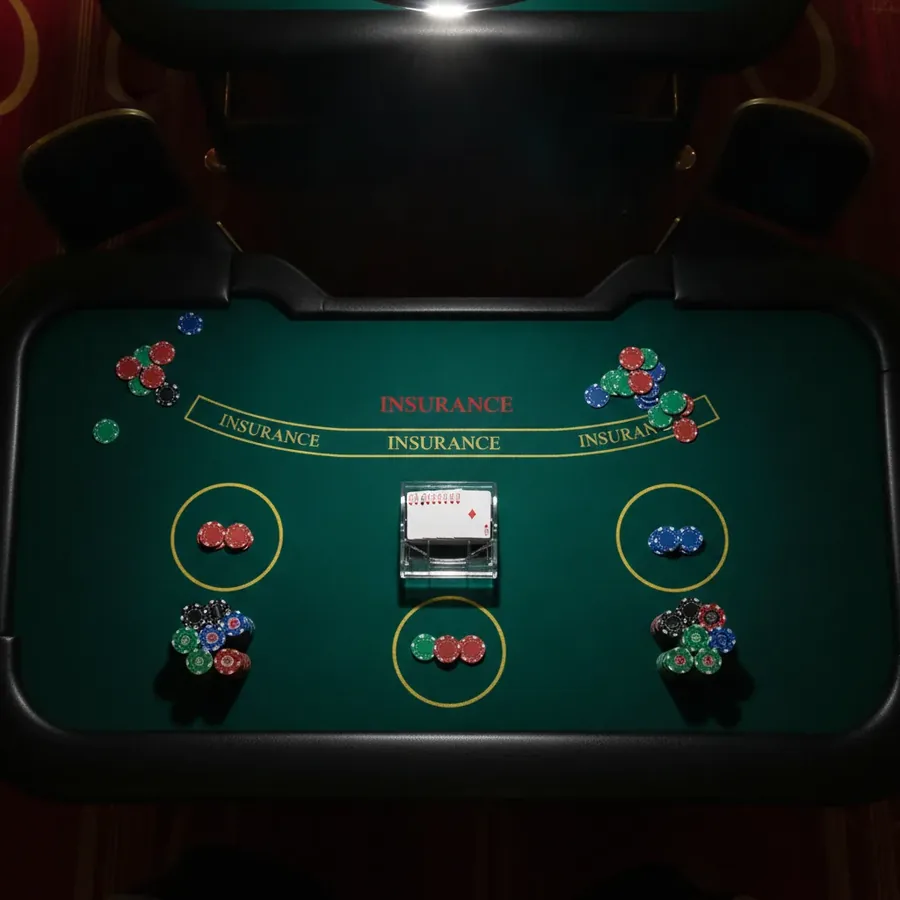
What doesn't count as Blackjack after Split?
When a player splits a pair of Aces in certain blackjack variants, such as Blackjack Split / Double / H17, the resulting hands may have specific limitations. For instance, if an Ace is drawn to a split Ace, it might not be considered a blackjack, even if it totals 21. This rule can affect payouts and the overall house advantage.
The Blackjack Split / Double / H17 rule set can modify the RTP based on specific game modifications. However, the impact of not counting a split Ace as a blackjack on a 21 total needs careful consideration within the game's specific logic.
Understanding these nuances is crucial for players aiming for optimal strategy. A hand totaling 21 formed by splitting Aces might not qualify for the standard blackjack payout of 3:2 or 6:5. This scenario, while rare, represents a specific edge case where a player achieves 21 points but does not receive the highest possible payout due to splitting rules.
Insurance vs Even Money on Own Blackjack
Blackjack Insurance, available in variations like Blackjack Insurance / Versicherung (6–8 Decks), is a side bet offered when the dealer's upcard is an Ace. It pays 2:1 if the dealer has a blackjack. However, the RTP for this bet is a low 92.53%, leading to a substantial house advantage of 7.47%.
Even Money, which is an option when a player has a blackjack and the dealer shows an Ace, pays 1:1 on the player's bet. This is distinct from the Insurance side bet. While Insurance pays 2:1 on the side bet, its high house edge makes it disadvantageous. Even Money, by contrast, secures a payout on the initial bet, avoiding the risk of a push if the dealer does not have blackjack.
The Basisstrategie, or basic strategy, explicitly advises against taking the Insurance bet in most scenarios, except for advanced card counters when the true count is +3 or higher. This recommendation stems from the significantly lower RTP of the insurance bet, making it a financially detrimental choice for the average player compared to accepting Even Money or letting the hand play out.
Set session stop after 30 percent loss
Adopting a session stop limit of 30 percent loss is a prudent risk management strategy, particularly when playing games with a variable house edge. For instance, Blackjack Auszahlung 6:5 statt 3:2 (6 Decks) has a house advantage of 1.85%, meaning a player's bankroll can deplete faster than at tables with lower house edges.
Considering the RTP of various blackjack games can inform session stop decisions. Blackjack Ein Deck, klassische Regeln, 3:2 offers a high RTP of 99.85% with a house advantage of 0.15%. Playing such a variant may allow for longer sessions before a 30 percent loss is reached, compared to a game like Blackjack Insurance, which has an RTP of 92.53%.
Implementing a strict 30 percent loss limit ensures that players do not exceed their predetermined budget, regardless of the game's volatility or house edge. This disciplined approach is essential for maintaining control and preventing significant financial setbacks, especially when facing games like Blackjack Auszahlung 6:5 where the house edge is notably higher.
Bonus Lost Due to 10 Percent Contribution
The 300% welcome bonus up to €2,000 plus 100 free spins has specific wagering requirements where table games contribute only 10% to the bonus turnover. This means that for every 10 EUR wagered on table games, only 1 EUR counts towards fulfilling the bonus conditions.
This limited contribution from table games, such as Blackjack Party or Infinite Blackjack by Evolution, significantly extends the time and amount of wagering required to clear the bonus. For example, to wager the full €2,000 bonus, a player betting exclusively on table games would need to wager a total of 40,000 EUR (2,000 EUR bonus x 10% contribution x 40 wagering requirement).
Players aiming to utilize the bonus with table games must be aware that achieving the wagering requirement will be substantially slower. This makes the 100 free spins, which likely contribute 100% to turnover, a more direct path to releasing bonus funds if table game play is prioritized. Slot games, contributing 100%, offer a faster route to bonus completion.
Blackjack variants at a glance
| Variant | Payout | House edge | Rule | Bet range |
|---|---|---|---|---|
| Blackjack Surrender (Late Surrender) – Regel-Effekt | n.a. (Regel-Modifikator) | −0.08 Prozentpunkte | Spieler gibt Hand nach Dealer-Blackjack-Prüfung auf, verliert die Hälfte des Einsatzes. Verbessert RTP um ca. 0.08 Prozentpunkte. Early Surrender ist wesentlich wertvoller (bis −0.6 Prozentpunkte), aber extrem selten. | Rückzahlung 50% des Einsatzes |
| Blackjack 6 Decks, S17, DAS, DOA, Auszahlung 3:2, Basisstrategie | 99.54% | 0.46% | Dealer steht auf Soft 17; Verdopplung auf jeder Zweierkarte; Verdopplung nach Split erlaubt; keine Aufgabe. Basisstrategie ist für diesen Wert zwingend | Blackjack 3:2, normaler Gewinn 1:1, Insurance 2:1 |
| Blackjack Ein Deck, klassische Regeln, 3:2 | 99.85% | 0.15% | Weniger Decks = niedrigerer Vorteil; ein Deck gibt ca. −0.48 Prozentpunkte gegenüber 8 Decks. Oft durch 6:5 Auszahlung kompensiert. | Blackjack 3:2, Gewinn 1:1 |
| Blackjack Insurance / Versicherung (6–8 Decks) | 92.53% | 7.47% | Separate Nebenwette bis 50% der Hauptwette, wenn der Dealer ein Ass hat. Basisstrategie schreibt IMMER Ablehnung vor (außer Karten zählen bei True Count ≥ +3). Bei einem Deck Vorteil ≈ 5.88% | Insurance 2:1 |
| Blackjack Liberal Vegas Strip (liberale Regeln, 3:2) | 99.72% | 0.28% | Günstigste Regelkombination: S17 + DAS + Resplit + Late Surrender. Standardabweichung 1,15 | Blackjack 3:2, Gewinn 1:1 |
| Blackjack Auszahlung 6:5 statt 3:2 (6 Decks) | 98.15% | 1.85% | Ersatz von 3:2 durch 6:5 fügt exakt +1.39 Prozentpunkte zum Vorteil des Casinos hinzu – stärker als jede andere Regeländerung. Bei $10 Einsatz zahlt Blackjack $12 statt $15. | Blackjack 6:5, Gewinn 1:1 |
Infinite Blackjack vs Classic Seven-Seat Table
Infinite Blackjack from Evolution offers an unlimited number of seats, distinguishing it from classic seven-seat tables that are limited to seven players. This variation allows for a potentially boundless player count, unlike the fixed capacity of traditional setups. Players can participate without waiting for an available seat, a significant advantage over tables with limited seating that can lead to queues.
The betting range for Infinite Blackjack is from 1 EUR to 5,000 EUR, providing flexibility for a wide spectrum of players. This range is notably broader than some other live blackjack offerings, accommodating both casual players and high rollers. The extended betting limits ensure that a diverse player base can engage with the game comfortably within their budget.
While classic tables might offer a more intimate feel with fewer players, Infinite Blackjack prioritizes accessibility and continuous play. The game's design aims to maximize player engagement by eliminating waiting times, a common frustration at tables with limited capacity. This focus on immediate access caters to players who prefer to start playing without delay.
Step-by-step Split at the Live Table
Resplitting Aces is a rule that can improve a player's RTP by approximately 0.08 percentage points. This specific action allows players to split Aces more than once if they receive another Ace after the initial split. Many live blackjack variations, including those at Joya Casino, permit this strategic maneuver, offering a more favorable outcome for the player.
Doubling down after a split (DAS) is another key rule variation that enhances player options and RTP by around 0.14 percentage points. This enables players to double their bet on hands that result from a split, providing an opportunity for greater winnings. Such flexibility in betting decisions is often available at live blackjack tables.
The ability to split cards and then double down on the resulting hands can significantly alter the game's dynamics, increasing strategic possibilities. Rules such as allowing splits and doubles after splits are implemented in various live blackjack games, such as the Blackjack 6 Decks variant with an RTP of 99.54%. These actions are crucial for players aiming to optimize their play.
Stand-on-17 Rule and Its Meaning for Players
The rule where the dealer stands on a soft 17 (S17) is a favorable condition for players, reducing the house edge by approximately 0.22 percentage points. In such games, the dealer's turn ends once their hand totals 17 or more, even if it includes an Ace counted as 11. This rule is a common feature in many blackjack variants.
Conversely, when the dealer hits on a soft 17 (H17), the house edge increases, negatively impacting the player's theoretical return. This means the dealer will draw another card if their hand is a soft 17. For instance, Blackjack 6 Decks, with an RTP of 99.54%, operates under the S17 rule, offering a lower house advantage than H17 games.
Understanding the S17 rule is crucial for players employing basic strategy, as it directly influences optimal decision-making. Games like Blackjack Liberal Vegas Strip, featuring an RTP of 99.72%, often incorporate the S17 rule as part of its player-friendly conditions. This distinction between S17 and H17 can noticeably affect long-term profitability.
RNG draws cards from virtual eight-deck shoe
Many virtual blackjack games utilize an eight-deck shoe, a common configuration that influences card distribution and player strategy. For example, Blackjack 6 Decks, with an RTP of 99.54%, draws from a shoe that might typically contain six decks, though eight is also prevalent in RNG versions. The number of decks can slightly alter the house edge.
The use of multiple decks, such as in an eight-deck shoe, contributes to a higher house edge compared to single-deck games. While a game like Blackjack Ein Deck boasts an RTP of 99.85%, an eight-deck shoe typically results in a slightly lower RTP due to increased card permutation complexity. This is a standard practice in RNG blackjack.
The specific number of decks in the shoe, whether six or eight, is a rule variation that impacts the game's mathematics. For instance, a game using six decks might offer a slightly better RTP than an equivalent game using eight decks, all other rules being equal. This detail, along with payouts like 3:2, is key to understanding game fairness.
Bust at 22: Stake Lost Immediately
In certain blackjack variants, busting with a score of 22 or higher results in an immediate loss of the player's stake, regardless of the dealer's hand. This rule is a standard feature in many blackjack games, including those with liberal rules like Blackjack Liberal Vegas Strip, which has an RTP of 99.72%. The outcome is definitive upon exceeding 21.
The risk of busting with a 22 is a constant factor in blackjack, and the consequence of losing the bet instantly adds to the game's inherent volatility. For example, if a player's hand totals 22, their bet is forfeit. This is a fundamental rule across most blackjack variations, irrespective of the number of decks or payout ratios.
Understanding that any hand exceeding 21 leads to an automatic loss is paramount for all blackjack players. Whether playing live variants like Quantum Blackjack Plus Live with an RTP of 99.57% or RNG-based games, the principle remains the same: a score of 22 or more signifies a lost round. This rule underscores the importance of strategic play.
Side Bets Increase House Edge to 5 Percent
The Blackjack Insurance side bet, often presented with an RTP of 92.53%, carries a significant house edge of 7.47%. This bet is offered when the dealer shows an Ace, allowing a player to wager up to 50% of their main bet. Basic strategy dictates avoiding this bet unless card counting indicates a true count of +3 or higher, where the advantage shifts.
When compared to the main Blackjack game with classic rules and a 3:2 payout, which boasts an RTP of 99.85% and a house edge of 0.15%, the Insurance bet is substantially less favorable. Even a single-deck game with a 3:2 payout offers a lower house edge than this side bet. The Insurance bet pays 2:1.
This difference in house edge means that for every 100 EUR wagered on Blackjack Insurance, players can theoretically expect to lose 7.47 EUR over the long term, contrasting sharply with the 0.15 EUR loss expected from the main game. The higher house edge on side bets like Insurance can quickly diminish a player's bankroll.
What doesn't count towards turnover at 10 percent?
Table games, including Blackjack and other card games, contribute only 10% towards meeting wagering requirements for bonuses. For example, a 100 EUR bet on a table game generates only 10 EUR in turnover credit. This applies to games such as Blackjack Liberal Vegas Strip with an RTP of 99.72%.
The welcome bonus offers a substantial 300% match up to 2,000 EUR plus 100 free spins, but the limited contribution of table games necessitates significant play on slots to fulfill wagering. To reach a 4,000 EUR turnover requirement from a 100 EUR bet on table games would require 400 such bets.
In contrast, slots contribute 100% towards turnover, meaning a 100 EUR bet on slots counts as 100 EUR towards wagering. This stark difference makes slots the primary game for players aiming to clear bonus funds efficiently, as demonstrated by the 10% contribution rate for table games.
Check table limit before the first bet
Table limits vary significantly across different Blackjack variants available at the casino. For instance, Infinite Blackjack, an Evolution provider game, allows bets ranging from 1 EUR to 5,000 EUR. This broad range caters to a wide spectrum of players, from casual bettors to high rollers.
Live dealer games like Quantum Blackjack Plus Live by Playtech feature a betting range of 1 EUR to 5,000 EUR, offering quantum multipliers of up to 1,000x on three-card 21-point hands with an RTP of 99.57%. Players should be aware of these limits to manage their bankroll effectively.
Blackjack Party, also from Evolution, has a more restricted betting range of 1 EUR to 1,000 EUR, focusing on a lively atmosphere with two hosts. Understanding these maximum bet amounts before placing a wager is crucial for managing expectations and ensuring bets align with personal financial strategies.
Ace Split: only one card per hand
When players split Aces in certain Blackjack variants, the rules often restrict them to receiving only one additional card per hand. This rule, common in many Blackjack games, impacts the strategic options available to the player after the split, limiting further doubling down or hitting opportunities.
For example, in Blackjack Split/Double/H17 variations, splitting Aces typically allows for only one card per hand. While splitting Aces is generally a strong move, this restriction can alter its overall effectiveness, especially when compared to variations where multiple cards might be permitted.
This limitation means that a player who splits Aces and receives a ten or a face card on one of the new hands, resulting in a total of 11, cannot draw another card to potentially improve their hand further. This specific rule has a direct consequence on the possible outcomes of a split Ace.
Surrender vs Playing Out on 16 vs 10
The Blackjack Surrender rule, specifically Late Surrender, allows a player to forfeit half of their bet after the dealer checks for Blackjack, reducing the house edge by approximately 0.08%. This option is beneficial when facing a strong dealer upcard, such as a 10.
When a player holds a hard 16 and the dealer shows a 10, basic strategy often suggests surrendering rather than playing out the hand. Playing out a hard 16 against a dealer's 10 without the surrender option leads to a higher expected loss compared to forfeiting half the bet.
While Late Surrender is advantageous, Early Surrender, which allows players to give up their hand before the dealer checks for Blackjack, is significantly more valuable but is exceptionally rare. The RTP improvement from Late Surrender is approximately 0.08%, highlighting its strategic importance.
Contact
Live - online chat
Banking









Providers












joya casino 2025